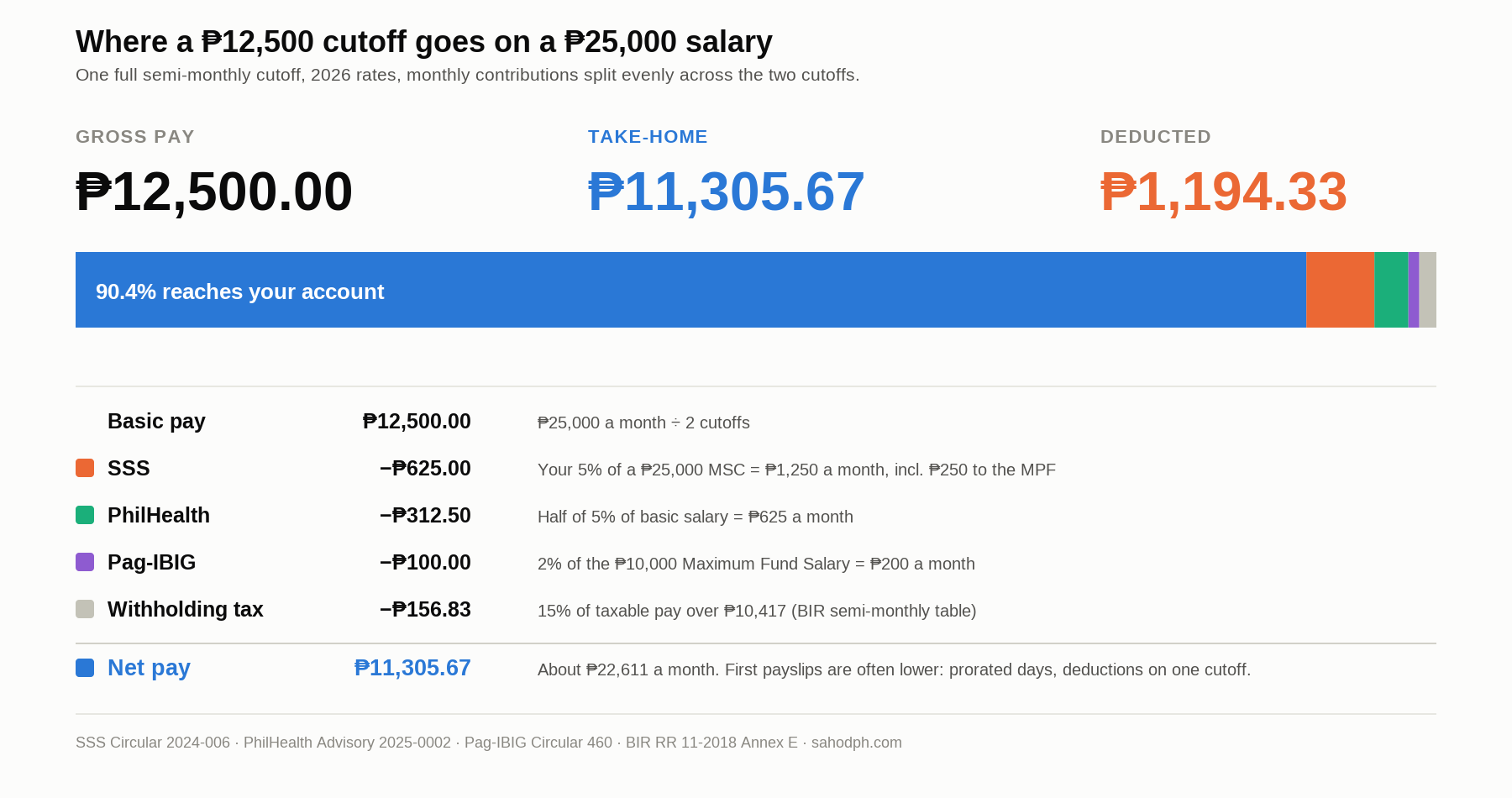
If you earn ₱25,000 a month and get paid every 15th and 30th, a full cutoff pays ₱12,500 gross. After 2026 deductions you take home about ₱11,305.67. That's roughly ₱22,611 a month.
Four deductions make up the gap: SSS, PhilHealth, Pag-IBIG and withholding tax. They come to about ₱2,389 a month, and most of it is mandatory savings and insurance, not tax.
Your first payslip will probably be smaller than this. Below is every line, in the order most payslips print them, followed by the reasons the first one looks different.
The example
We use one salary all the way through:
- Monthly basic salary: ₱25,000
- Pay schedule: semi-monthly (twice a month), cutoffs on the 1st–15th and 16th–end of month
- Work week: Monday to Friday, rest days unpaid
- No allowances, overtime or absences, unless a section says otherwise
Most Philippine private-sector payslips follow the same layout. There's an earnings block, a deductions block and the net pay at the bottom. Labels vary by payroll system, but the math doesn't.
Earnings
Basic pay: ₱12,500
This is your monthly salary divided across the cutoffs. Semi-monthly means two cutoffs a month, so each one carries half:
₱25,000 ÷ 2 = ₱12,500 per cutoff
Some payslips also show a daily rate and an hourly rate. Payroll uses these for overtime, absences and prorating. For a five-day week with unpaid rest days, the usual divisor is 261 working days a year:
₱25,000 × 12 ÷ 261 = ₱1,149.43 a day
₱1,149.43 ÷ 8 hours = ₱143.68 an hour
You can check your own with the Daily Rate Converter.
Allowances and de minimis benefits
Many employers add rice, clothing or laundry allowances. The BIR calls these de minimis benefits, meaning small perks that are tax-free up to set limits. Revenue Regulations No. 29-2025, issued in December 2025, raised the ceilings to:
- Rice subsidy: ₱2,500 a month (or one 50-kg sack worth no more than ₱2,500)
- Uniform and clothing allowance: ₱8,000 a year
- Laundry allowance: ₱400 a month
Within those limits, an allowance raises your gross pay but not your taxable pay. Anything above the limit is taxed like salary. PhilHealth also leaves allowances out: its premium is based on your monthly basic salary only.
Our example has no allowances, so this line is blank.
Overtime and night differential
Under the Labor Code, overtime on an ordinary workday pays your hourly rate plus at least 25% (Article 87). Work between 10 p.m. and 6 a.m. earns a night shift differential of at least 10% of your hourly rate for each hour (Article 86).
At ₱143.68 an hour, two hours of regular-day overtime would add:
₱143.68 × 1.25 × 2 hours = ₱359.20
Overtime counts toward your taxable pay. It doesn't change your SSS or PhilHealth unless it pushes your monthly SSS compensation into a higher bracket. Use the Overtime & Holiday Pay Calculator or the Night Differential Calculator for your own hours. Our example has none.
Gross pay: ₱12,500
Gross pay is basic pay plus everything else you earned in the cutoff. With no extras, it's the same as basic pay: ₱12,500.
Deductions
The amounts below are your employee share for the whole month. Your employer pays its own, larger share on top. That share never appears as a deduction from your pay.
SSS: ₱1,250 a month
Under SSS Circular No. 2024-006, which took effect in January 2025 and is still the current schedule, contributions are 15% of your Monthly Salary Credit (MSC). You pay 5% and your employer pays 10%.
The MSC is your monthly pay rounded into a ₱500 bracket, from ₱5,000 up to ₱35,000. A ₱25,000 salary falls in the ₱24,750–₱25,249.99 range, so your MSC is ₱25,000:
₱25,000 MSC × 5% = ₱1,250
The circular splits that ₱1,250 in two. The part covering the first ₱20,000 of MSC goes to the Regular SS Program, which pays sickness, maternity, disability, retirement and death benefits. The part above ₱20,000 goes to the Mandatory Provident Fund (MPF), a separate retirement savings account in your name:
Regular SS:  ₱20,000 × 5% = ₱1,000
MPF:          ₱5,000 × 5% = ₱250
Total employee share       = ₱1,250
Your payslip usually shows one SSS line. The split happens inside SSS. Your employer pays ₱2,500 plus a ₱30 Employees' Compensation contribution. Check other salaries with the SSS Contribution Calculator.
PhilHealth: ₱625 a month
PhilHealth's premium has been 5% of your monthly basic salary since 2024. A ₱10,000 floor and ₱100,000 ceiling apply, and PhilHealth Advisory No. 2025-0002 kept the same rate for January 2025 onward. A July 2026 PhilHealth advisory still cites 5%. The premium is shared equally between you and your employer, so your share is 2.5%:
₱25,000 × 5% = ₱1,250 total premium
₱1,250 ÷ 2 = ₱625 employee share
If you earn less than ₱10,000, you're still charged on ₱10,000. Above ₱100,000, the premium stops rising. See the PhilHealth Contribution Calculator.
Pag-IBIG: ₱200 a month
Pag-IBIG Fund Circular No. 460 raised the Maximum Fund Salary to ₱10,000 from February 2024. That's the highest salary Pag-IBIG computes your savings on. Employees earning over ₱1,500 a month contribute 2%, and so does the employer. At the ₱10,000 cap:
₱10,000 × 2% = ₱200 employee share
Any salary above ₱10,000 pays the same ₱200, so the line won't change when you get a raise. Your employer adds another ₱200. These are savings in your name, not a fee. Check with the Pag-IBIG Contribution Calculator.
Withholding tax: about ₱313.75 a month
Withholding tax is your income tax, collected a little at a time from each payslip. Your employer computes it on your taxable pay: gross pay minus your SSS, PhilHealth and Pag-IBIG shares, which the tax code exempts.
₱25,000 − ₱1,250 − ₱625 − ₱200 = ₱22,925 taxable a month
Under the TRAIN law's rates for 2023 onward, the first ₱250,000 of yearly taxable income is tax-free. The next ₱150,000 is taxed at 15%:
₱22,925 × 12 = ₱275,100 a year
(₱275,100 − ₱250,000) × 15% = ₱3,765 a year
₱3,765 ÷ 12 = ₱313.75 a month
That's the figure our Income Tax Calculator shows. On a semi-monthly payroll, your employer will more likely use the BIR's semi-monthly withholding table (Annex "E" of Revenue Regulations No. 11-2018). It taxes 15% of the amount over ₱10,417 per cutoff:
₱12,500 − ₱1,037.50 contributions = ₱11,462.50 taxable this cutoff
(₱11,462.50 − ₱10,417) × 15% = ₱156.83
Two cutoffs at ₱156.83 come to ₱313.66 a month. The BIR table rounds its brackets to whole pesos, so different methods can be a few centavos apart. The year-end adjustment, explained below, settles the difference.
Net pay: ₱11,305.67
Assuming your employer splits each monthly contribution evenly across the two cutoffs, one full cutoff looks like this:
| Line | Amount |
|---|
| Basic pay | ₱12,500.00 |
| Gross pay | ₱12,500.00 |
| SSS (employee share) | −₱625.00 |
| PhilHealth (employee share) | −₱312.50 |
| Pag-IBIG (employee share) | −₱100.00 |
| Withholding tax | −₱156.83 |
| Net pay | ₱11,305.67 |
Over a month, that's about ₱22,611 take-home on a ₱25,000 salary, or roughly 90 centavos of every peso. Use the Payslip Generator to build the same breakdown for your own salary.
Why your first payslip looks different
The first cutoff is prorated
You're paid only for the days you were on the payroll. Say you started on Monday, October 5, 2026. The October 1–15 cutoff has 11 working days, and you worked 9 of them.
One common method divides the cutoff's pay by its working days:
₱12,500 ÷ 11 working days × 9 days worked = ₱10,227.27
Employers don't all prorate the same way. Some multiply your daily rate by the days you worked. Others deduct the days you missed from ₱12,500. Each gives a slightly different figure, so check your contract or ask HR which one yours uses. The Prorated Salary Calculator lets you try either working days or calendar days.
A short first month can also change your SSS. The SSS table uses your compensation for the month. In this example, October pay is ₱10,227.27 + ₱12,500 = ₱22,727.27. That falls in the ₱22,250–₱22,749.99 range, so October's SSS would be ₱1,125, not ₱1,250. PhilHealth is based on your monthly basic salary rate, so it generally stays at ₱625. Pag-IBIG stays at ₱200.
Deductions may all land on one cutoff
Some employers split contributions across both cutoffs, as in the table above. Many take them all on one cutoff, usually the second, and leave the first almost untouched. A first paycheck with no SSS line isn't necessarily a mistake. It may just mean the full month comes off the next one.
Your monthly total doesn't change either way, but the two paychecks will look very different. If your employer takes all contributions on the second cutoff and computes tax per cutoff with the BIR table, the month looks roughly like this:
Cutoff 1: ₱12,500 − ₱312.45 tax                        = ₱12,187.55
Cutoff 2: ₱12,500 − ₱2,075 contributions − ₱1.20 tax   = ₱10,423.80
Month total                                             = ₱22,611.35
Your tax gets trued up in December
Withholding assumes you'll earn the same salary all year. A fresh graduate who starts in October doesn't. From October 5 to December, our example earns about ₱72,700 in basic pay. That's far below the ₱250,000 tax-free threshold, so the tax actually due for 2026 is zero.
Under Revenue Regulations No. 11-2018, your employer must run a year-end adjustment, or annualization, on your actual pay for the year. If more was withheld than you owe, the excess must be refunded or credited no later than January 25 of the following year. Many fresh graduates see that refund in their last payslip of December or their first in January.
The BIR Form 2316 arrives by January 31
Your employer must give you a BIR Form 2316 (Certificate of Compensation Payment/Tax Withheld) on or before January 31 of the following year. If you leave before December, you get it with your last pay. It lists everything you earned and every peso of tax withheld.
Keep it. If 2026 was your only job and the tax was withheld correctly, the signed 2316 counts as your income tax return under substituted filing, so you don't file a separate BIR Form 1700. If you change jobs, your next employer will ask for it. For a walkthrough of each box, see our BIR Form 2316 guide.
Your 13th month is prorated too
Under Presidential Decree No. 851, your 13th month pay is due no later than December 24. It equals one-twelfth of the basic salary you earned during the calendar year. Starting in October, the example works out to:
₱10,227.27 + ₱12,500 + ₱25,000 + ₱25,000 = ₱72,727.27 basic salary earned
₱72,727.27 ÷ 12 = ₱6,060.61
The TRAIN law exempts the 13th month and other bonuses from tax up to ₱90,000 combined a year, so none of this is taxed. PhilHealth's premium also excludes it. See the 13th Month Pay Calculator, or our easy computation guide for more examples.
What to check on your payslip
- Basic pay matches half your monthly salary, or the prorated amount in your first cutoff.
- SSS matches the 2026 table for your salary: ₱1,250 a month at ₱25,000.
- PhilHealth is 2.5% of your basic salary: ₱625 a month at ₱25,000.
- Pag-IBIG is ₱200 a month on any salary above ₱10,000.
- Withholding tax is zero if your taxable pay is ₱20,833 a month or less. Above that, it should be close to what the Income Tax Calculator shows.
- Year-to-date totals, if your payslip shows them, should add up across cutoffs. They're what your 2316 will show.
If a line doesn't match and your employer splits deductions differently from the example, ask HR or payroll how they compute it.
Sources